

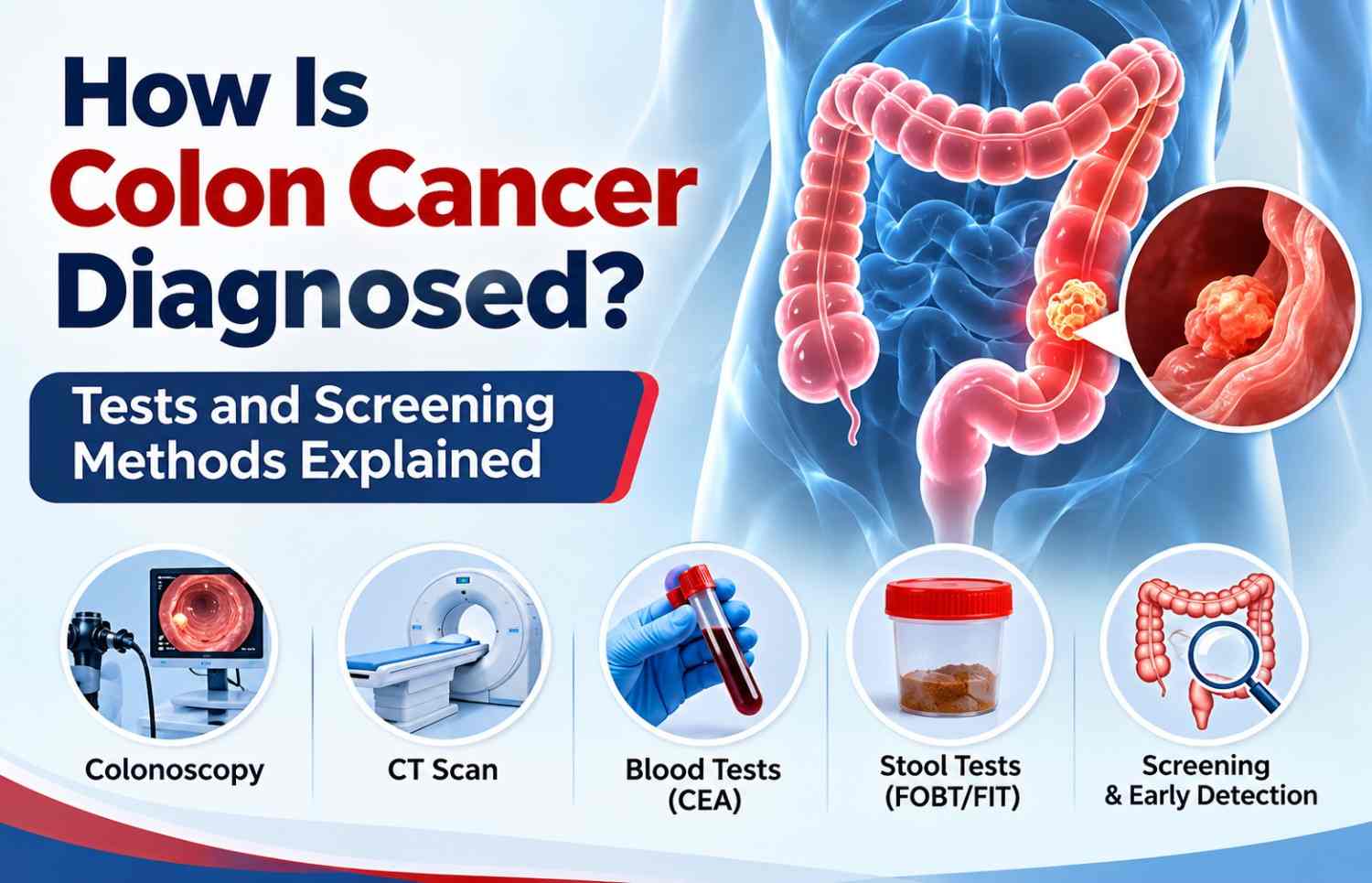
Colon cancer is one of the most common types of cancer affecting the digestive system. It develops when abnormal cells grow uncontrollably in the colon (large intestine), often beginning as small growths called polyps. While these polyps are usually non-cancerous, some can gradually develop into cancer if they are not detected and treated at the right time.
One of the biggest challenges with colon cancer is that it may not cause noticeable symptoms during its early stages. Some people experience changes in bowel habits, blood in their stool, unexplained weight loss, or persistent abdominal discomfort, while others may have no symptoms at all.
This is why understanding how colon cancer is diagnosed is so important. Modern diagnostic tests, including colonoscopy, stool-based screening, biopsy, and imaging scans, help doctors identify abnormal growths, confirm cancer, and determine whether it has spread to other parts of the body.
Under the guidance of an experienced surgical oncologist like Dr. Kamlesh Verma, Best Cancer Surgeon in Lucknow, patients can receive appropriate evaluation and understand the available treatment options. Let’s explore the important tests and screening methods used to diagnose colon cancer.
1. What Are the First Steps in Diagnosing Colon Cancer?
The diagnosis of colon cancer usually begins with a detailed discussion about the patient’s symptoms, medical history, and family background. A doctor may recommend further investigations if there are symptoms or findings that suggest a problem in the colon.
During the initial consultation, the doctor may ask about:
-
Persistent changes in bowel habits, including constipation or diarrhoea.
-
Blood in the stool or rectal bleeding.
-
Unexplained weight loss.
-
Frequent abdominal pain, cramps, or bloating.
-
A family history of colon cancer or colorectal polyps.
-
Previous inflammatory bowel conditions.
-
Unexplained tiredness or weakness that may indicate anaemia.
A physical examination may also be performed. Depending on the symptoms and risk factors, the doctor may recommend blood tests, stool tests, or a colonoscopy.
It is important to understand that these symptoms do not automatically indicate cancer. However, persistent or unexplained symptoms should never be ignored.
2. Colonoscopy: The Most Important Test for Colon Cancer

A colonoscopy is one of the most reliable and commonly recommended procedures for detecting colon cancer. It allows doctors to examine the entire large intestine using a thin, flexible tube fitted with a small camera and light.
The procedure helps identify abnormal growths, polyps, inflammation, bleeding, and suspicious areas inside the colon.
How is a colonoscopy performed?
-
The patient is asked to follow specific dietary instructions and take bowel-cleansing medication before the procedure.
-
The patient may receive sedation to improve comfort.
-
A flexible colonoscope is gently inserted through the rectum.
-
The doctor examines the inner lining of the colon on a monitor.
-
If suspicious polyps or abnormal tissues are found, they may be removed or a tissue sample may be collected for further examination.
Why is colonoscopy important?
-
Detects abnormal growths before they become cancerous.
-
Helps identify early-stage colon cancer.
-
Allows doctors to remove many polyps during the same procedure.
-
Helps determine whether a suspicious area requires a biopsy.
A colonoscopy can help prevent certain cases of colorectal cancer by identifying and removing precancerous polyps.
3. Biopsy: Confirming Whether Colon Cancer Is Present

Finding an abnormal growth during a colonoscopy does not necessarily mean that a person has cancer. To confirm the diagnosis, doctors generally recommend a biopsy.
A biopsy involves collecting a small sample of suspicious tissue from the colon. This sample is sent to a pathology laboratory, where a specialist examines it under a microscope.
What does a biopsy reveal?
-
Whether the abnormal tissue is cancerous or non-cancerous.
-
The type of cells involved.
-
Whether the growth represents a particular form of colorectal cancer.
-
Additional tumour characteristics that may help guide treatment.
In most cases, a tissue biopsy provides the definitive confirmation of colon cancer. Further pathology and molecular tests may be recommended to understand the tumour’s characteristics and help doctors select an appropriate treatment plan.
4. Stool Tests for Early Detection of Colon Cancer

Stool-based screening tests are useful for detecting possible signs of colorectal cancer, particularly in people who do not have symptoms but are eligible for screening.
These tests look for hidden blood or other indicators that may suggest an abnormality in the digestive tract.
Some commonly used stool tests include:
A. Fecal Immunochemical Test (FIT)
FIT checks for small amounts of hidden blood in the stool that may not be visible to the naked eye. It detects human haemoglobin and is commonly used for colorectal cancer screening.
B. Guaiac-Based Fecal Occult Blood Test (gFOBT)
This test checks stool samples for hidden blood using a chemical reaction. Certain foods and medications may affect the results, so patients should follow the doctor’s instructions.
C. Stool DNA Test
Some stool DNA tests examine stool samples for abnormal DNA changes and blood associated with colorectal cancer or advanced precancerous growths.
Important: A positive stool test does not confirm colon cancer. It indicates that further investigation, usually a colonoscopy, is required. Similarly, a negative result does not completely rule out cancer, particularly when symptoms are present.
5. Blood Tests Used in Colon Cancer Diagnosis
Blood tests cannot independently confirm colon cancer. However, they provide important information about the patient’s overall health and may help doctors identify complications.
Commonly recommended blood tests include:
Complete Blood Count (CBC): This test measures red blood cells, white blood cells, and platelets. Low haemoglobin levels may indicate anaemia, which can sometimes occur due to slow, continuous bleeding from a colon tumour.
Liver Function Tests (LFTs): These tests help assess liver health. They may be useful when doctors are evaluating whether cancer could have affected the liver.
Carcinoembryonic Antigen (CEA): CEA is a tumour marker that may be elevated in some people with colorectal cancer. It is not suitable as a standalone screening or diagnostic test because levels can also increase due to other conditions. Doctors commonly use it to establish a baseline and monitor treatment response or possible recurrence in selected patients.
These investigations help doctors understand the patient’s condition and plan further evaluation.
6. CT Scan, MRI and PET-CT: Checking Whether Cancer Has Spread
Once colon cancer is confirmed, imaging tests help doctors determine the size and location of the tumour and whether it has spread to nearby tissues or distant organs.
A. CT Scan (Computed Tomography)
A CT scan uses X-rays and computer technology to produce detailed images of internal organs. It is commonly used to evaluate the abdomen, pelvis, and chest.
It helps doctors assess:
-
The size and location of the tumour.
-
Possible involvement of nearby lymph nodes.
-
Whether cancer has spread to the liver, lungs, or other organs.
B. MRI Scan (Magnetic Resonance Imaging)
MRI uses magnetic fields and radio waves to create detailed images of internal structures. It may be recommended when doctors need a closer examination of the liver or other specific areas.
C. PET-CT Scan
A PET-CT scan combines metabolic imaging with detailed anatomical imaging. It is not routinely required for every colon cancer patient but may be recommended in selected cases when doctors need additional information about suspected cancer spread or recurrence.
These imaging investigations help determine the extent of the disease and support treatment planning.
7. What Are the Different Stages of Colon Cancer?
After confirming colon cancer, doctors perform staging to understand how far the disease has progressed. The TNM staging system is commonly used for this purpose.
| Stage | Description |
|---|---|
| Stage 0 | Abnormal cancerous cells are limited to the innermost lining. |
| Stage I | Cancer has grown into deeper layers of the colon wall but has not spread to nearby lymph nodes. |
| Stage II | Cancer has grown through the colon wall or into nearby structures without regional lymph node involvement. |
| Stage III | Cancer has spread to nearby lymph nodes. |
| Stage IV | Cancer has spread to distant organs, such as the liver or lungs. |
Accurate staging is essential because treatment recommendations depend on the stage, tumour characteristics, the patient’s overall health, and other clinical factors.
8. When Should You Get Screened for Colon Cancer?
Colon cancer screening helps identify precancerous polyps and early-stage cancer before noticeable symptoms develop.
Screening recommendations depend on age, family history, personal medical history, and individual risk factors.
People who may need earlier or more frequent screening include:
-
Individuals with a close family history of colorectal cancer.
-
People with a previous history of colorectal polyps.
-
Individuals diagnosed with inflammatory bowel diseases such as ulcerative colitis or Crohn’s disease involving the colon.
-
People with inherited conditions associated with colorectal cancer, such as Lynch syndrome or familial adenomatous polyposis (FAP).
In some international guidelines, average-risk adults are advised to begin colorectal cancer screening at age 45. However, screening recommendations can differ between countries and medical organisations. In India, screening decisions should be discussed with a qualified doctor based on personal risk and available clinical guidance.
Remember that people experiencing symptoms should seek medical evaluation rather than waiting until they reach a routine screening age.
9. Why Early Diagnosis of Colon Cancer Matters
Early diagnosis can make a significant difference in the management of colon cancer. When the disease is detected before it spreads, treatment may be less extensive, and the chances of successful treatment are generally better.
Some important benefits of early detection include:
-
Identifying and removing precancerous polyps.
-
Detecting cancer before it spreads to distant organs.
-
Improving treatment planning.
-
Reducing the risk of complications associated with advanced disease.
-
Providing access to appropriate surgical and other treatment options.
Modern cancer care offers several treatment approaches, including surgery, chemotherapy, targeted therapy, and immunotherapy for selected patients, depending on the tumour’s stage and molecular characteristics.
10. Consult Dr. Kamlesh Verma for Colon Cancer Evaluation in Lucknow

If you are experiencing persistent digestive problems, unexplained rectal bleeding, changes in bowel habits, or other concerning symptoms, seeking timely medical advice is important.
Dr. Kamlesh Verma, MBBS, MS, MCh (Surgical Oncology), M.Ch (Cancer Surgery, TATA Memorial Hospital, Mumbai), is a surgical oncologist associated with advanced cancer care in Lucknow.
As an experienced cancer surgeon, he evaluates patients with different types of cancer and helps determine suitable treatment approaches based on their diagnosis and medical condition.
At CareMyCancer, patients can explore reliable information about cancer symptoms, diagnostic procedures, treatment options, and the importance of early medical consultation.
Do not ignore persistent warning signs. Timely evaluation can help identify the problem and ensure that appropriate medical care is started when needed.
Frequently Asked Questions (FAQs)
1. What is the most accurate test for diagnosing colon cancer?
Colonoscopy with biopsy is one of the most reliable approaches to diagnosing colon cancer. Colonoscopy allows doctors to examine the colon, while biopsy confirms whether suspicious tissue contains cancer cells.
2. Can colon cancer be detected through a blood test?
No. Routine blood tests cannot confirm colon cancer. Tests such as CBC and CEA may provide supporting information, but colonoscopy and tissue biopsy are generally required for diagnosis.
3. Is colonoscopy painful?
Colonoscopy is generally well tolerated. Sedation is commonly offered to reduce discomfort. Some patients may experience temporary bloating or abdominal cramps after the procedure.
4. At what age should colon cancer screening begin?
Several international guidelines recommend starting average-risk colorectal cancer screening at age 45. However, recommendations vary by country and individual risk. People with a family history or other high-risk factors may need earlier screening.
5. Can colon cancer be detected before symptoms appear?
Yes. Screening methods such as FIT and colonoscopy can identify potential signs of colorectal cancer or precancerous polyps before symptoms develop.